
Style
Retatrutide vs Ozempic vs Wegovy (Full Comparison Guide)
Jun
Retatrutide vs Ozempic vs Wegovy (Full Comparison Guide)
Introduction: Three Drugs, One Question
If you have been researching weight loss injections in the UK, three names keep appearing: Ozempic, Wegovy, and retatrutide. All three are injectable medications. All three work by targeting hormone receptors involved in appetite and metabolism. And all three have generated enormous public interest — Ozempic and Wegovy because they are already transforming lives across the UK, and retatrutide because its early clinical data suggests it may be even more powerful than both.
But for anyone trying to make a practical decision, the comparisons can be confusing. Ozempic and Wegovy contain the same active ingredient but are licensed for different conditions. Retatrutide is not yet approved in the UK at all. The weight loss figures quoted in headlines come from different types of trials with different patient populations. And the costs, availability, and side effect profiles vary significantly.
This guide cuts through that confusion. We compare all three drugs across every dimension that matters — mechanism, efficacy, safety, UK availability, cost, and who each drug is actually right for — using the best available clinical evidence.
⚡ Quick answer for busy readers: Ozempic and Wegovy are available in the UK now through regulated channels. Retatrutide is not yet approved and is unlikely to be before 2027. If you need help with weight management today, Wegovy or Mounjaro (tirzepatide) are your strongest regulated options.
Quick Drug Profiles
Ozempic (Semaglutide 0.5mg / 1mg / 2mg)
Ozempic is a once-weekly injectable semaglutide developed by Novo Nordisk. It was originally developed and licensed for the treatment of type 2 diabetes. Its weight loss effects were discovered as a significant secondary benefit. Because it is licensed for diabetes rather than obesity, its approved doses (up to 2mg) are lower than Wegovy’s, which produces less dramatic weight loss in direct comparisons.
- Active ingredient: Semaglutide
- Licensed UK use: Type 2 diabetes management
- UK approval date: 2019 (MHRA)
- Injection frequency: Once weekly
- Average weight loss (diabetes dose): ~6–8% of body weight
- Private cost: ~£80–£120 per month
Wegovy (Semaglutide 2.4mg)
Wegovy is the same active ingredient as Ozempic — semaglutide — but at a higher dose (2.4mg weekly) specifically optimised and licensed for weight management in people with obesity. Think of it as the weight loss version of the same drug. Because it uses a higher dose, its weight loss results are significantly better than standard Ozempic doses.
- Active ingredient: Semaglutide (higher dose than Ozempic)
- Licensed UK use: Chronic weight management in adults with obesity
- UK approval date: 2023 (MHRA)
- Injection frequency: Once weekly
- Average weight loss: ~15% of body weight (STEP trials)
- Private cost: ~£200–£300 per month
Retatrutide
Retatrutide is a next-generation injectable developed by Eli Lilly. Unlike semaglutide-based drugs, it targets three hormone receptors simultaneously (GLP-1, GIP, and Glucagon), which is believed to be responsible for its superior weight loss figures in early trials. It is currently in Phase 3 clinical trials and has not been approved by the MHRA or any major regulatory authority.
- Active ingredient: Retatrutide (LY3437943)
- Licensed UK use: None — not yet approved
- Developer: Eli Lilly
- Injection frequency: Once weekly (in trials)
- Average weight loss: ~24% of body weight (Phase 2 — not yet confirmed in Phase 3)
- UK private cost: Not available through regulated channels
Side-by-Side Comparison: All Key Factors
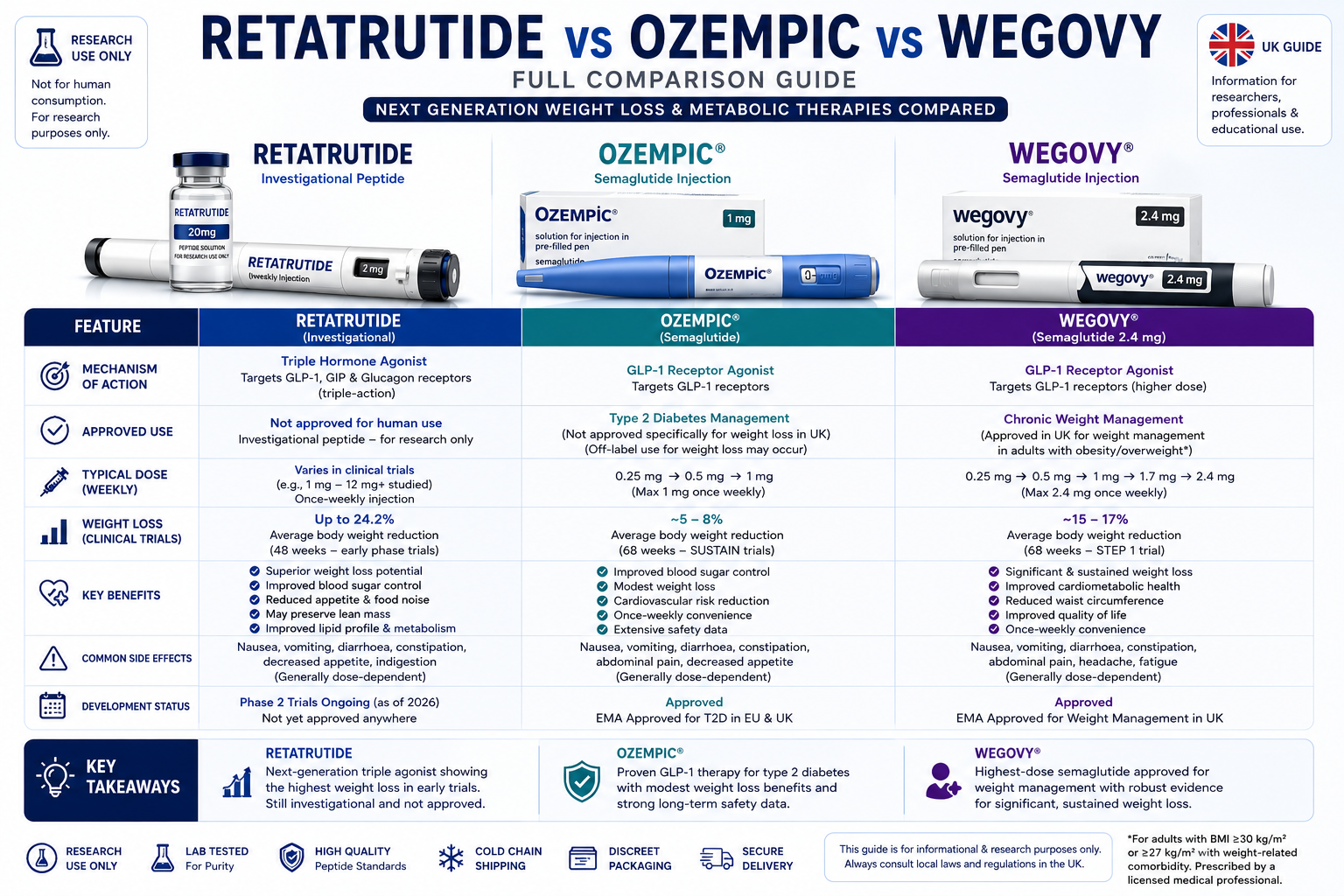
| Factor | Retatrutide | Ozempic (Semaglutide) | Wegovy (Semaglutide) |
| Drug class | Triple agonist (GLP-1/GIP/Glucagon) | GLP-1 agonist | GLP-1 agonist |
| Developer | Eli Lilly | Novo Nordisk | Novo Nordisk |
| Primary use | Obesity (trial stage) | Type 2 diabetes | Obesity / weight management |
| Avg. weight loss | ~24% (Phase 2) | ~6–8% (diabetes dose) | ~15% (high dose) |
| Injection frequency | Once weekly | Once weekly | Once weekly |
| UK approval | Not approved | MHRA approved ✓ | MHRA approved ✓ |
| NHS availability | No | Yes (T2D) | Yes (obesity) |
| Est. private cost/mo | N/A (unavailable) | ~£80–£120 | ~£200–£300 |
| Peak dose | 12 mg (trial) | 2 mg | 2.4 mg |
| Liver fat reduction | Yes (strong signal) | Moderate | Moderate |
| Cardiovascular trial | Ongoing (TRIUMPH-3) | SUSTAIN-6 (positive) | SELECT trial (positive) |
Mechanism: How Each Drug Works
| Receptor | Retatrutide | Ozempic / Wegovy | Effect on body |
| GLP-1 | ✅ Yes | ✅ Yes | Reduces hunger; slows digestion; improves insulin |
| GIP | ✅ Yes | ❌ No | Boosts fat metabolism; reduces GI side effects |
| Glucagon | ✅ Yes | ❌ No | Increases energy expenditure; targets liver fat |
Why the Extra Receptors Matter So Much
The jump in efficacy from Ozempic/Wegovy to retatrutide is not simply a matter of a higher dose — it reflects a fundamentally different biological approach. Each additional receptor target adds a separate mechanism of action:
- GLP-1 alone (Ozempic/Wegovy): reduces hunger and slows digestion. Average ~15% weight loss at obesity-optimised doses.
- GLP-1 + GIP (Mounjaro/tirzepatide): adds metabolic enhancement and fat cell improvements. Average ~22% weight loss.
- GLP-1 + GIP + Glucagon (Retatrutide): adds significant energy expenditure boost and liver fat targeting. Average ~24% weight loss in Phase 2.
Each layer amplifies the previous one. The glucagon component in particular is significant because it does something the other mechanisms cannot: it increases how much energy the body burns at rest. This means retatrutide is simultaneously reducing calorie intake (via GLP-1/GIP appetite suppression) and increasing calorie expenditure (via glucagon) — two directions at once.
Efficacy: The Weight Loss Numbers in Context
Ozempic — What the Trials Show
Ozempic’s weight loss data comes primarily from the SUSTAIN trial series, which studied its effects in people with type 2 diabetes. At the 1mg dose, participants lost approximately 6.5% of body weight on average over 56 weeks. At the 2mg dose, this rose to approximately 9.6%. These figures are meaningful for a diabetic population, but are lower than what later obesity-specific drugs achieved.
It is important to note that Ozempic was not designed for obesity — it was designed for blood sugar management. Its weight loss effects are a significant bonus, but the doses approved for diabetes are not optimised for maximum weight loss.
Wegovy — What the Trials Show
The STEP (Semaglutide Treatment Effect in People with obesity) trial programme tested semaglutide at 2.4mg — the Wegovy dose — specifically in people with obesity. The results were a significant step forward:
- STEP 1: 14.9% average weight loss over 68 weeks vs 2.4% placebo
- STEP 2 (with T2D): 9.6% average weight loss
- STEP 3 (with intensive behavioural therapy): 16% average weight loss
- STEP 4 (continuation): Maintained weight loss; regain on stopping
The SELECT cardiovascular outcomes trial published in 2023 also showed that Wegovy reduced major cardiovascular events by 20% in people with obesity and established heart disease — a landmark result that strengthened the case for NHS access significantly.
Retatrutide — What the Trials Show
Retatrutide’s Phase 2 results, published in the New England Journal of Medicine (June 2023), showed dose-dependent weight loss across all active groups. At the highest trial dose (12mg weekly), participants lost an average of 24.2% of body weight over 48 weeks — and the weight loss curve had not plateaued, suggesting even greater loss was possible with longer treatment.
However, these are Phase 2 results. Phase 2 trials are designed to establish efficacy signals and dosing — they are smaller and shorter than Phase 3 trials. Phase 3 results (expected 2025–2026) will be the definitive test of whether these results hold at scale across a more diverse patient population.
📊 The numbers in plain terms: If you weigh 100 kg, Ozempic (diabetes dose) might help you lose 6–9 kg. Wegovy could help you lose ~15 kg. Retatrutide, based on Phase 2 data, could help you lose ~24 kg — though this is not yet confirmed at Phase 3 scale.
Side Effects: How Do They Compare?
| Side effect | Retatrutide | Ozempic | Wegovy | Severity |
| Nausea | Very common (>40%) | Common (20–30%) | Common (20–30%) | Mild–Moderate |
| Vomiting | Common | Common | Common | Mild–Moderate |
| Diarrhoea | Common | Common | Common | Mild |
| Constipation | Common | Common | Common | Mild |
| Decreased appetite | Very common | Very common | Very common | Beneficial |
| Fatigue | Uncommon | Uncommon | Uncommon | Mild |
| Pancreatitis | Rare | Rare | Rare | Severe — seek help |
| Thyroid concerns | Under monitoring | Class warning | Class warning | Monitoring required |
| Muscle loss | Under investigation | Possible | Possible | Under study |
The side effect profiles of all three drugs are broadly similar — a consequence of their shared GLP-1 mechanism. Gastrointestinal effects (nausea, vomiting, diarrhoea) are the most common, particularly during dose escalation, and typically reduce over time as the body adjusts.
Where retatrutide may differ is in the degree of gastrointestinal effects at higher doses, due to the additional glucagon component. Phase 2 data showed that side effects were manageable and consistent with the drug class, but Phase 3 will provide more detailed safety data across a larger population over a longer period.
✅ Managing side effects: For all three drugs, starting at a low dose and escalating gradually (the standard protocol) significantly reduces gastrointestinal side effects. Eating smaller meals, avoiding high-fat foods, and staying hydrated all help during the adjustment period.
UK Availability: What Can You Actually Get Right Now?
| Route | Retatrutide | Ozempic | Wegovy |
| NHS prescription | ❌ Not available | ✅ For type 2 diabetes | ✅ Specialist referral |
| Private prescription | ❌ Not available | ✅ ~£80–120/mo | ✅ ~£200–300/mo |
| Online pharmacy | ❌ Not safely available | ✅ Regulated UK pharmacies | ✅ Regulated UK pharmacies |
| Clinical trial | ✅ TRIUMPH trials recruiting | N/A — already approved | N/A — already approved |
| Grey market | ⚠️ Unregulated risk | ⚠️ Counterfeit risk exists | ⚠️ Counterfeit risk exists |
Getting Ozempic in the UK
Ozempic is available on NHS prescription for people with type 2 diabetes, subject to eligibility criteria. It can also be obtained through private prescriptions from registered UK pharmacies and regulated online pharmacy services. Due to global supply shortages in recent years, availability has at times been constrained — always use regulated, MHRA-registered pharmacies.
Getting Wegovy in the UK
Wegovy became available through NHS specialist weight management services in 2024, subject to NICE eligibility criteria (generally BMI 35+ with a weight-related condition, or BMI 30+ with high cardiovascular risk). Private prescriptions are available from registered UK clinics and pharmacies at approximately £200–£300 per month. Demand has been high and supply has at times been limited.
Getting Retatrutide in the UK
There is currently no legal, regulated route to obtain retatrutide in the UK. The only legitimate access point is through participation in a registered clinical trial. Research chemical suppliers do sell substances labelled as retatrutide, but these are not MHRA-regulated and carry significant risks including contamination, mislabelling, and incorrect dosing.
⚠️ Warning: Several websites market retatrutide to UK consumers. None of these are operating through legitimate UK pharmaceutical channels. Products sold this way have no quality guarantee and may pose serious health risks.
Head-to-Head: Who Wins Each Category?
| Category | Winner | Reason |
| Raw weight loss | Retatrutide* | *Phase 2 only; Phase 3 pending |
| UK availability right now | Ozempic / Wegovy | MHRA approved; NHS & private access |
| Safety track record | Ozempic / Wegovy | Years of real-world data vs months of trial data |
| Ease of access | Ozempic | Widest prescribing base; longest on market |
| Liver fat reduction | Retatrutide (likely) | Glucagon component shows strong signal in trials |
| Cost (private) | Ozempic | Significantly cheaper than Wegovy; retatrutide N/A |
| Type 2 diabetes use | Ozempic | Licensed specifically for T2D; retatrutide not yet |
| Long-term data | Ozempic / Wegovy | Multi-year real-world data; SUSTAIN & SELECT trials |
Who Should Choose Which Drug?
Choose Ozempic if…
- You have type 2 diabetes and need blood sugar management alongside weight loss
- You want the most established drug with the longest real-world safety record
- Cost is a concern — Ozempic is the most affordable of the three privately
- Your GP or specialist has recommended it for your specific clinical situation
Choose Wegovy if…
- Your primary goal is weight loss and you do not have type 2 diabetes
- You meet NHS eligibility criteria (BMI 35+ with a comorbidity, or BMI 30+ with high CV risk)
- You want the strongest currently available and MHRA-approved weight loss injection
- You are interested in the cardiovascular protection benefits demonstrated in the SELECT trial
Wait for Retatrutide if…
- You have already tried approved GLP-1 drugs without achieving adequate results
- You are prepared to wait until 2027 or later for a regulated UK option
- You are eligible and willing to participate in a clinical trial (the only safe current route)
- Your clinician believes the additional glucagon mechanism may be specifically beneficial for your metabolic profile (particularly liver fat)
✅ Practical recommendation for most UK readers: Start with what is available and regulated now. Wegovy (or Mounjaro, if your clinician agrees) gives you strong results through a safe, supervised pathway. If retatrutide receives MHRA approval and proves its Phase 3 results, you can reassess with your doctor at that point.
Frequently Asked Questions
Is retatrutide stronger than Ozempic and Wegovy?
Based on Phase 2 trial data, yes — retatrutide’s 24.2% average weight loss significantly exceeds Ozempic’s ~6–8% (at diabetes doses) and Wegovy’s ~15%. However, Phase 2 results are not the same as confirmed Phase 3 results, and a direct head-to-head trial comparing all three has not been conducted. The comparison is also complicated by the fact that the trials used different patient populations and durations.
Is Ozempic the same as Wegovy?
Same active ingredient (semaglutide), different doses and licensed indications. Ozempic is licensed for type 2 diabetes at doses up to 2mg. Wegovy is licensed specifically for obesity at 2.4mg. The higher dose in Wegovy is what produces significantly better weight loss results. They are manufactured by the same company (Novo Nordisk) and work through the same mechanism.
Can I switch from Ozempic or Wegovy to retatrutide when it is approved?
Potentially, yes — though this would be a clinical decision made with your doctor based on your individual situation, response to current treatment, and retatrutide’s approved indications at the time. Switching between drugs in this class is medically possible, but requires careful management and a wash-out period.
Why is retatrutide not approved yet if it works better?
Regulatory approval requires large-scale Phase 3 trials demonstrating efficacy and safety in thousands of patients over longer periods. Phase 2 trials, while promising, are smaller proof-of-concept studies. Phase 3 results for retatrutide are expected in 2025–2026. Only after those results — if positive — would Eli Lilly file for approval, and the MHRA review process itself takes a further 12–18 months.
Does Ozempic cause cancer?
No cancer signal has been detected in human clinical trials for semaglutide (Ozempic or Wegovy). GLP-1 drugs carry a class label warning regarding thyroid C-cell tumours based on animal studies, but this effect has not been observed in humans in extensive real-world data. People with a personal or family history of medullary thyroid carcinoma or MEN2 syndrome should not use GLP-1 drugs.
What happens if I stop taking these drugs?
For all three drugs, significant weight regain is expected if treatment is stopped. STEP 4 data for semaglutide showed that patients who stopped Wegovy regained approximately two-thirds of lost weight within one year. This pattern is expected to be similar for retatrutide. These drugs currently appear to require ongoing use to maintain results — a significant consideration for long-term planning.
Conclusion: The Right Drug Is the One You Can Access Safely
Retatrutide’s Phase 2 data is the most impressive ever recorded for a weight loss drug. If Phase 3 confirms those results, it will represent a genuine advance beyond what Ozempic and Wegovy can offer. But impressive trial data and accessible medicine are not the same thing — and for UK residents in 2025, retatrutide is not accessible through any safe, regulated route.
Ozempic and Wegovy, by contrast, are proven, approved, and available today. Wegovy in particular — with its 15% average weight loss and demonstrated cardiovascular benefits — is a genuinely powerful medical tool that is already changing outcomes for thousands of people across the UK.
The right approach: use what works now, under proper medical supervision, and stay informed as retatrutide’s Phase 3 results emerge. The goal is not the most exciting drug — it is the most effective safe treatment available to you today.
-
Retatrutide vs Ozempic vs Wegovy (Full Comparison Guide)
